 How To
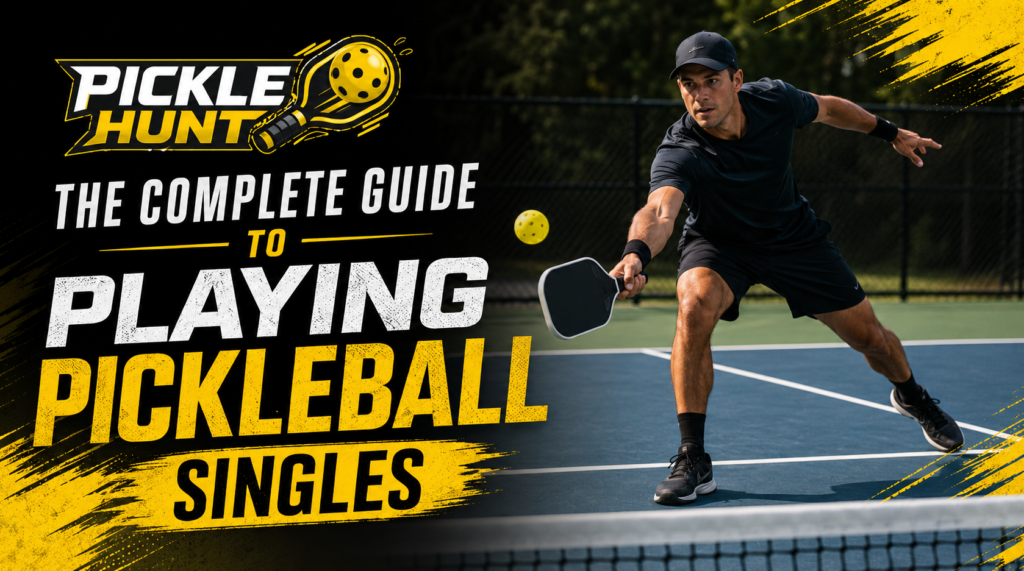
The Complete Guide to Playing Pickleball Singles
Yes, you can play pickleball 1v1. It’s a real, sanctioned format with its own rulebook, not just doubles with an empty half of the court. The core differences: a narrower court in play, a serving position that alternates by score instead of by partner, and no second-server rule.
This guide breaks down exactly how to play pickleball singles: court boundaries, serving rules, scoring, strategy, and the mistakes doubles players make the first time they step onto a singles court.
How to Play Pickleball Singles: The Basics
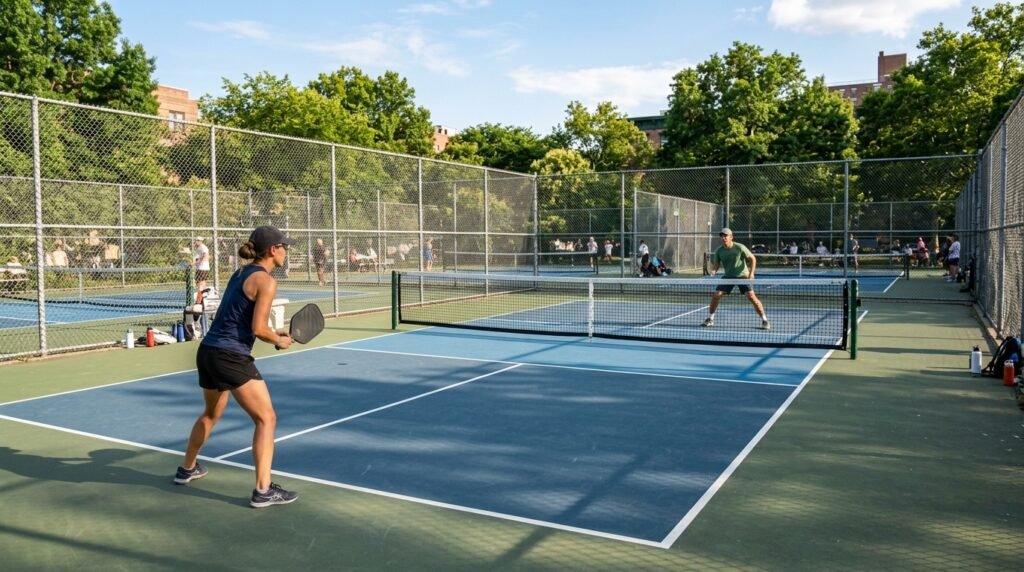
Singles pickleball uses the same court, same net height, and same paddle and ball as doubles. What changes is who covers the court and how the score determines where you serve from. One player per side. No partner to cover a weak shot or split the court in half. You’re responsible for the entire 20′ x 44′ space by yourself.
That single change reshapes almost everything about how the game is played, from shot selection to footwork to how long a point actually lasts.
Court Dimensions and Boundaries for Singles
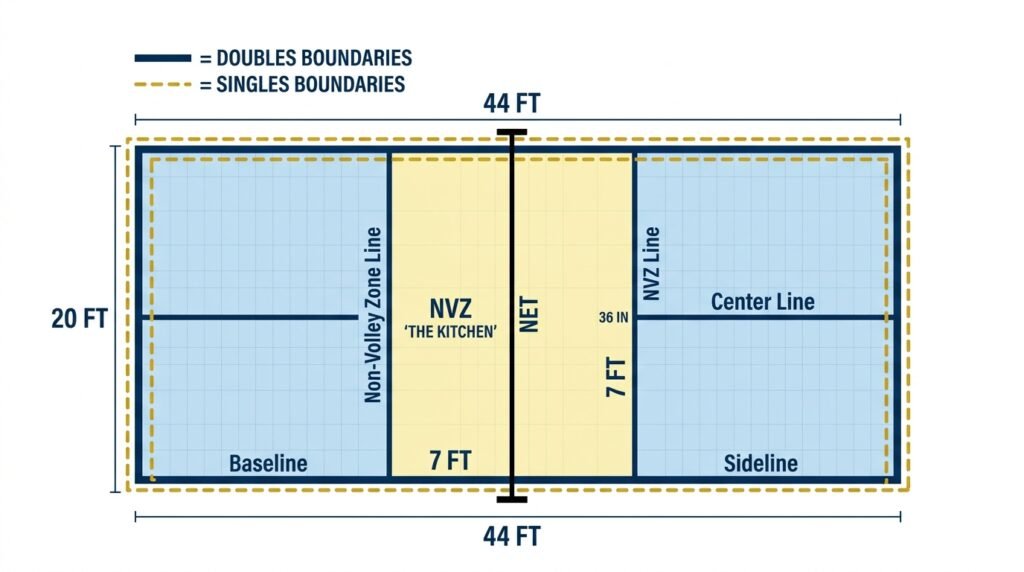
The pickleball court itself doesn’t shrink for singles. Every line on the court, baseline, sidelines, and non-volley zone, stays exactly where it is for doubles. The court is 20 feet wide and 44 feet long, split by a net at 34 inches in the center and 36 inches at the posts.
What matters in singles is that both sidelines are in play on every shot, since there’s no partner covering a lane. In doubles, some casual players get lazy about the outer few feet near the sideline because a partner might be shading that direction. In singles, that sideline space is exposed on every single rally.
The non-volley zone, or kitchen, rules stay identical: no volleying while standing inside the 7-foot zone on either side of the net. That part of the game doesn’t change no matter how many players are on the court.
Serving Rules in Singles Pickleball
This is where singles diverges most from doubles, and where beginners get tripped up.
Server position is based on score, not partner rotation
In doubles, the server position alternates between two players on a team. In singles, there’s only one player per side, so the rule shifts: you serve from the right side when your score is even, and from the left side when your score is odd.
That’s the entire rule. Check your own score before every serve, right side on even numbers (0, 2, 4, and so on), left side on odd numbers (1, 3, 5, and so on).
No second-server rule
Doubles pickleball gives each team two chances to serve before the ball goes to the other side, except at the very start of the game. Singles has no second-server rule. Each player only gets one serve attempt per turn. Fault on the serve, or lose the point during the rally, and the serve immediately goes to the other player.
This makes singles faster-paced in terms of serve turnover, even though individual points can run longer since there’s no partner to help finish them.
Serving mechanics stay the same
The actual serve motion, underhand, below the waist, diagonally into the opposite service box, doesn’t change between singles and doubles. If you already know how to serve in doubles, you already know the mechanics. The only adjustment is remembering which side to stand on based on your score.
Scoring Differences: Singles vs. Doubles
Singles scoring is actually simpler than doubles once you understand the server-position rule above. A few key points:
- Games are typically played to 11, win by 2, same as doubles.
- Only the server can score a point. If the returning player wins the rally, no point is scored, but the serve passes to them (a side-out).
- There’s no need to call a three-number score (server number, like you do in doubles). In singles, it’s just your score and your opponent’s score.
- A single fault ends your serve turn. No cushion from a second server. Every service fault immediately hands the serve to your opponent.
That single-fault rule is worth repeating because it changes how aggressively you should serve. A big power serve that goes in 70% of the time might be worth the risk in doubles, where a fault only costs you your one turn before your partner serves. In singles, that same fault gives your opponent the ball outright.
Singles Strategy: Covering the Court and Choosing Shots
Singles pickleball is a different physical and tactical challenge than doubles, mainly because of one fact: it’s just you out there.
You cover the entire court alone
There’s no partner to poach a shot down the middle or cover a lob to the back corner. Every ball, from sideline to sideline and kitchen line to baseline, is yours to get to. This is the single biggest adjustment for players coming from doubles.
Deep shots matter more
In doubles, the kitchen is often the main battleground since two players are packed close to the net. In singles, with one player covering the whole court, deep groundstrokes and baseline rallies play a bigger role. Pushing your opponent back with deep shots buys you time to get into better court position.
Movement and conditioning matter more than doubles
Singles is more physically demanding. You’re covering roughly twice the ground per point compared to doubles, where a partner shares the court. Points often last longer too, since there’s no partner available to finish off a rally with a quick put-away at the net. Fitness and footwork matter as much as paddle skill in singles.
Shot selection shifts
Aggressive net play still matters, but you can’t crowd the kitchen line as tightly as you might in doubles, since there’s no one covering your back court if you get lobbed. Balancing aggression at the net with the risk of leaving the back court open is one of the core strategic tensions in singles.
Common Mistakes Doubles Players Make in Singles
Forgetting the serve-side rule. Serving from the wrong side based on your score is the single most common beginner error moving from doubles to singles.
Crowding the net like it’s doubles. Without a partner covering the baseline, camping at the kitchen line leaves the whole back court open to a lob.
Underestimating the fitness demand. Singles points cover far more ground per rally. Players used to doubles often gas out faster than expected in their first few singles games.
Playing passively off the serve return. With no partner to bail you out, a weak or short return puts you immediately on the defensive for the rest of the point.
Ignoring the sidelines. Balls that would’ve been a partner’s responsibility in doubles are now squarely your job. Beginners often leave the outer few feet of the court unguarded out of habit.
If you’re ready to build out both formats, the Doubles Strategy article covers positioning and shot selection for two-person teams, and singles pairs well with practicing on a real court instead of a taped-up substitute. Use the Court Directory page to find dedicated courts near you.
FAQ
Can you play pickleball with two people?
Yes. Pickleball singles is a standard, rulebook-recognized format played 1v1 on the same court used for doubles. The main differences are serving position (based on score) and the absence of a second-server rule.
Can two people play pickleball?
Yes, two people can play a full singles match using the same court, net, and equipment as doubles. No special gear or court modifications are needed to play 1v1.
How is singles scoring different from doubles?
In singles, only the score determines which side you serve from (right side on even scores, left side on odd), and there’s no second-server rule. A single fault or lost rally immediately hands the serve to your opponent.
Is singles pickleball harder than doubles?
Physically, yes. One player covers the entire 20′ x 44′ court alone, so points tend to require more movement and endurance than doubles, where two players share the court space.
Do the court dimensions change for singles?
No. Singles pickleball uses the exact same court, net height, and boundary lines as doubles. The kitchen rules and court size stay identical, only the number of players changes.