 How To
How to Set Up a Tennis Court for Pickleball (Full Guide)
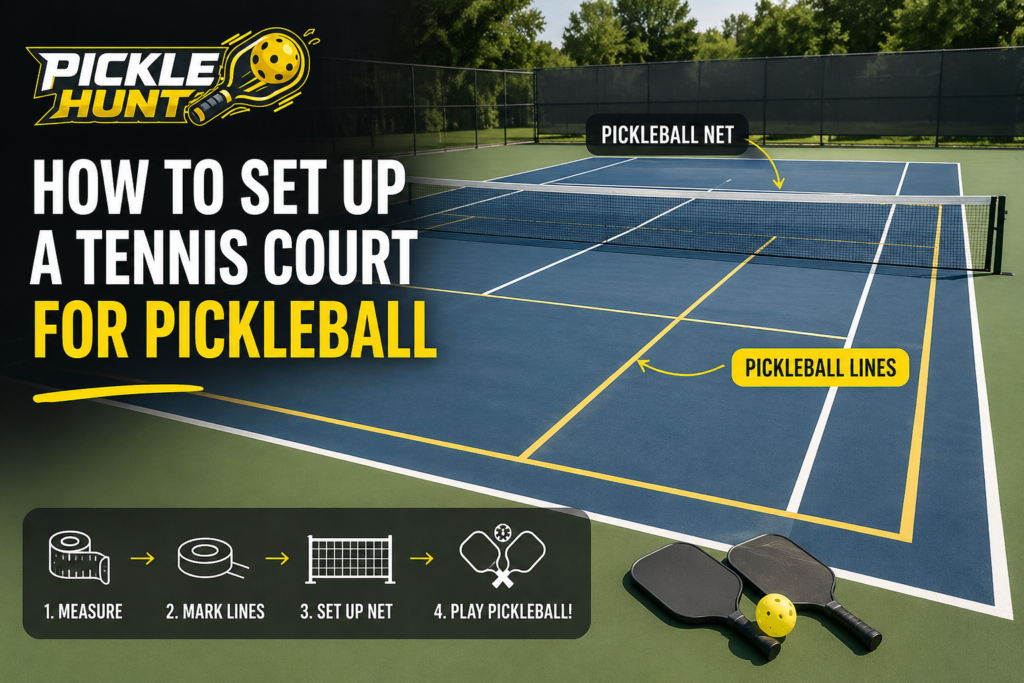
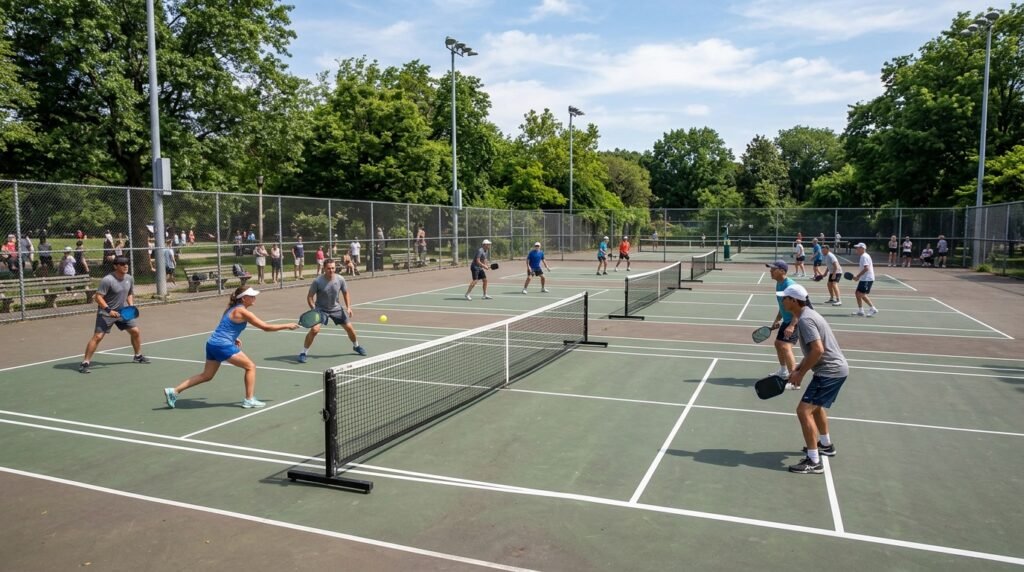
Yes, you can play pickleball on a tennis court. You need a portable net set to 34 inches at the center, and you need pickleball lines marked within the tennis court boundaries, either with tape, chalk, or a pop-up court overlay. No permanent construction required.
A standard tennis court (78′ x 36′ with doubles alleys) is big enough to fit two full pickleball courts side by side, or up to four if you use the full court length for cross-court setups. That’s why tennis courts are the most common conversion target for pickleball players who don’t have a dedicated court nearby.
This guide covers the exact dimensions, the step-by-step setup process, what not to do, and when converting a tennis court actually makes sense versus just finding a real pickleball court.
Can You Play Pickleball on a Tennis Court?
Short answer: yes. Tennis courts and pickleball courts share the same hard surface (asphalt or concrete), so there’s no structural barrier to playing pickleball on one. The differences are all in the markings and the net.
A tennis net sits at 36 inches at the posts and 3 feet at the center. A pickleball net needs to be lower: 36 inches at the sidelines and 34 inches at the center. Play pickleball on an unmodified tennis net and the game changes. Soft shots that should clear the net catch it instead, and the kitchen (non-volley zone) dynamics get thrown off.
So “can you play pickleball on a tennis court” really breaks into two questions: can the surface work (yes, always), and can you get the net and lines right (yes, with about 15 minutes of setup). Both are solvable without any permanent changes to the court.
Court Dimension Differences: Pickleball vs. Tennis
Here’s what you’re working with:
| Pickleball Court | Tennis Court | |
|---|---|---|
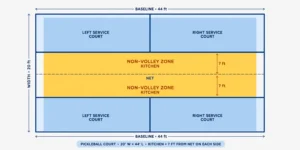
| Playing area | 20′ x 44′ | 78′ x 36′ (with doubles alleys) |
| Net height (center) | 34″ | 36″ |
| Net height (sideline) | 36″ | 36″ |
| Non-volley zone | 7′ from net, both sides | N/A |
A single pickleball court is a fraction of the size of a tennis court. That’s the whole reason conversions work: a tennis court has more than enough room to fit multiple pickleball courts inside its boundaries.
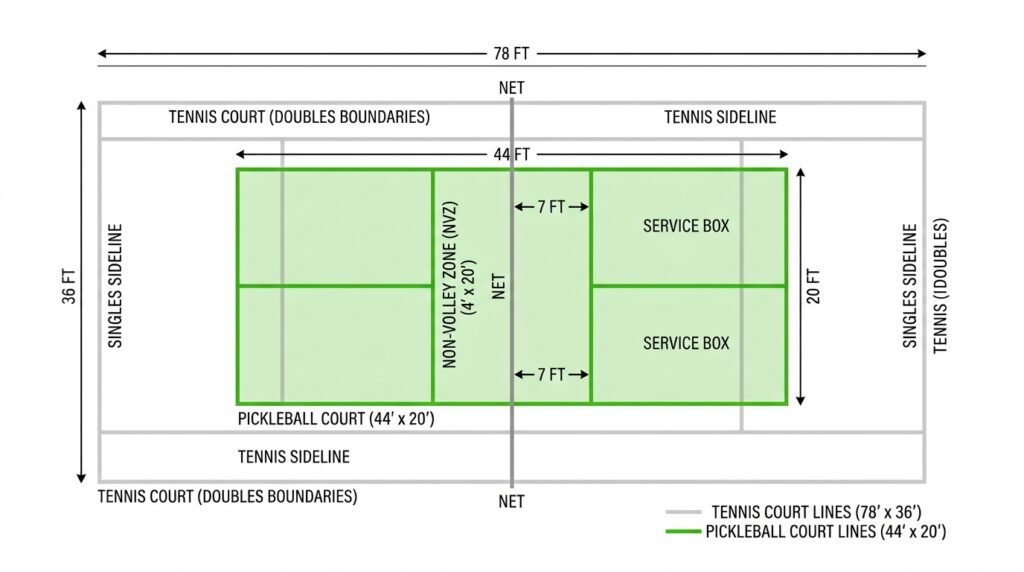
How many pickleball courts fit on one tennis court?
Two, comfortably, side by side across the width of the tennis court, using the existing baseline and sideline space. Some clubs squeeze in a third or fourth by using both the length and width of the doubles court, but two is the standard and most playable layout. You get real space around each court without players from adjacent games colliding mid-rally.
How to Play Pickleball on a Tennis Court: Step-by-Step Setup
Here’s the actual process, in order.
Step 1: Check the surface and get permission
If it’s a public court, check whether taping lines is allowed. Most municipal parks departments are fine with temporary tape as long as you remove it after play. Some private clubs have specific rules, so ask before you show up with a roll of tape and a tape measure.
Step 2: Mark the pickleball lines
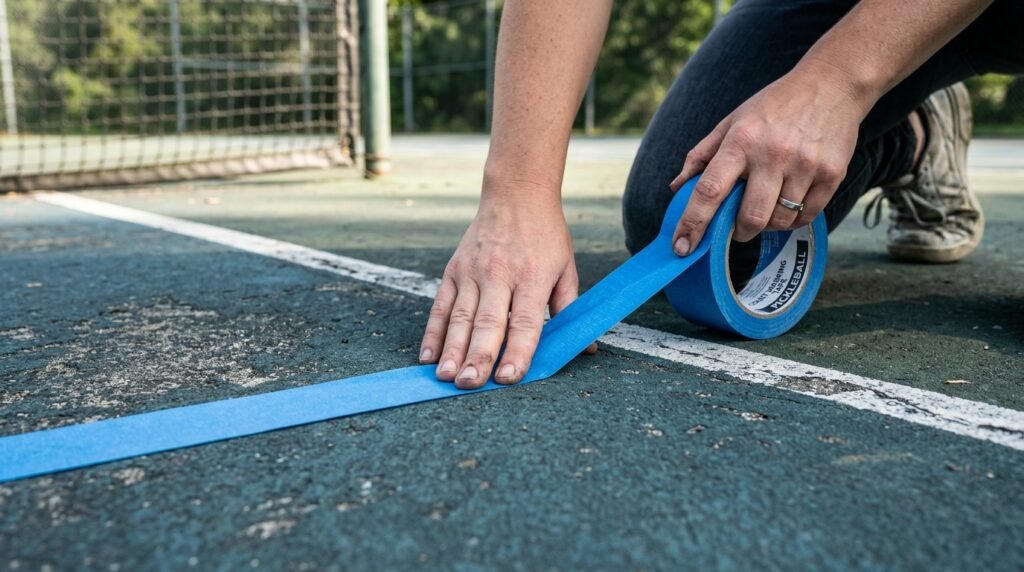
Use painter’s tape, court marking tape, or sidewalk chalk. Never permanent paint on a shared or public court (more on that below). Measure out a 20′ x 44′ rectangle within the tennis court boundaries. Use the tennis court’s existing baseline as a reference point to keep your lines straight and square.
Mark:
- The two sidelines (20′ apart)
- The baselines (44′ apart)
- The centerline splitting each service area
- The non-volley zone line, 7 feet from where the net will sit on each side
Step 3: Set up a portable net at the correct height
A tennis net will not work as-is. You need either:
- A portable pickleball net (freestanding, adjustable), or
- A tennis net temporarily adjusted down to pickleball height using a center strap or lowering device
Set it to 36 inches at the posts and 34 inches at the center. Use a tape measure, not a guess. A couple of inches off changes how the ball plays, especially on dinks and third-shot drops.
Step 4: Position the net correctly
The net should sit at the midpoint of your 44-foot court length, 22 feet from each baseline. If you’re squeezing two pickleball courts across one tennis court, make sure both nets line up and neither court’s baseline runs into the other’s playing space.
Step 5: Play, then clean up
If you used tape, pull it up when you’re done, especially on public courts where other groups need the space back for tennis. Chalk usually wears off on its own but check local rules first.
What NOT to Do When Converting a Tennis Court
A few mistakes come up constantly:
Don’t paint permanent lines on a public or shared court. This is the fastest way to get pickleball banned from a facility. Parks departments and clubs have had conflicts over this exact issue: unauthorized permanent markings on shared tennis courts. Stick to removable tape or chalk unless you have explicit written permission for permanent lines.
Don’t use a full-height tennis net. Playing with the net at 36 inches center instead of 34 inches doesn’t sound like much, but it noticeably changes soft-game shots. If you’re practicing for real play, get the height right.
Don’t ignore surface wear on old tennis courts. Cracked or heavily worn asphalt plays differently for pickleball’s lower, faster ball flight. It’s playable, but be aware that ball bounce may be less consistent than on a purpose-built pickleball surface.
Don’t set up in a spot where pickleball and tennis players will collide. If you’re one of two or more courts squeezed onto a single tennis court, leave enough buffer space so a hard tennis serve from an adjacent court doesn’t end up in your kitchen.
Don’t skip measuring the non-volley zone. Eyeballing the 7-foot kitchen line is one of the most common setup errors and it directly affects how the game plays, especially for anyone practicing drop shots or dinks.
When It’s Worth It vs. When to Find a Dedicated Court
Converting a tennis court makes sense when:
- You’re playing casually with friends and don’t need permanent lines
- Your area has no dedicated pickleball courts nearby
- You’re at a club or facility that allows temporary setups
- You just want to try the game before committing to gear or memberships
It’s not worth it when:
- You’re playing regularly and want consistent lines every time
- You want proper court sizing without remeasuring each session
- You’re in an area with real pickleball courts available
- You’re prepping for league or tournament play, where court conditions matter
If dedicated courts exist near you, they’ll almost always beat a converted tennis court on consistency, surface quality, and net setup. Check the Court Directory page to find dedicated pickleball courts in your area before defaulting to a DIY conversion.
And if you’re setting up a portable net or investing in your own gear for regular converted-court play, it’s worth choosing equipment built for it. Check our Gear reviews page for recommendations on paddles and portable net systems that hold up to repeated setup and teardown.
FAQ
Is a pickleball court the same as a tennis court?
No. A pickleball court is much smaller (20′ x 44′ compared to a tennis court’s 78′ x 36′) and uses a lower net (34 inches at center vs. 36 inches for tennis). A tennis court can fit multiple pickleball courts inside its boundaries.
How do you play pickleball on a tennis court?
Mark pickleball lines (20′ x 44′) inside the tennis court using tape or chalk, set up a portable net at 34 inches center height, and position it at the midpoint of your marked court. No permanent changes to the tennis court are needed.
Can you use a tennis net for pickleball?
Not without adjusting it. A tennis net sits too high for pickleball. You’ll need to lower it to 34 inches at the center using a strap or dedicated lowering device, or use a separate portable pickleball net instead.
Do I need special tape for the lines?
Painter’s tape or court marking tape both work. Painter’s tape is cheaper and easier to remove but wears out faster; court marking tape holds up better across multiple sessions but costs more.
How many pickleball courts fit on a tennis court?
Two courts side by side is the standard, playable setup. Some groups fit three or four with tighter spacing, but two gives players enough room to move without interfering with the adjacent game.