 Rules
Rules
How High Is a Pickleball Net: Full Height and Width Specs
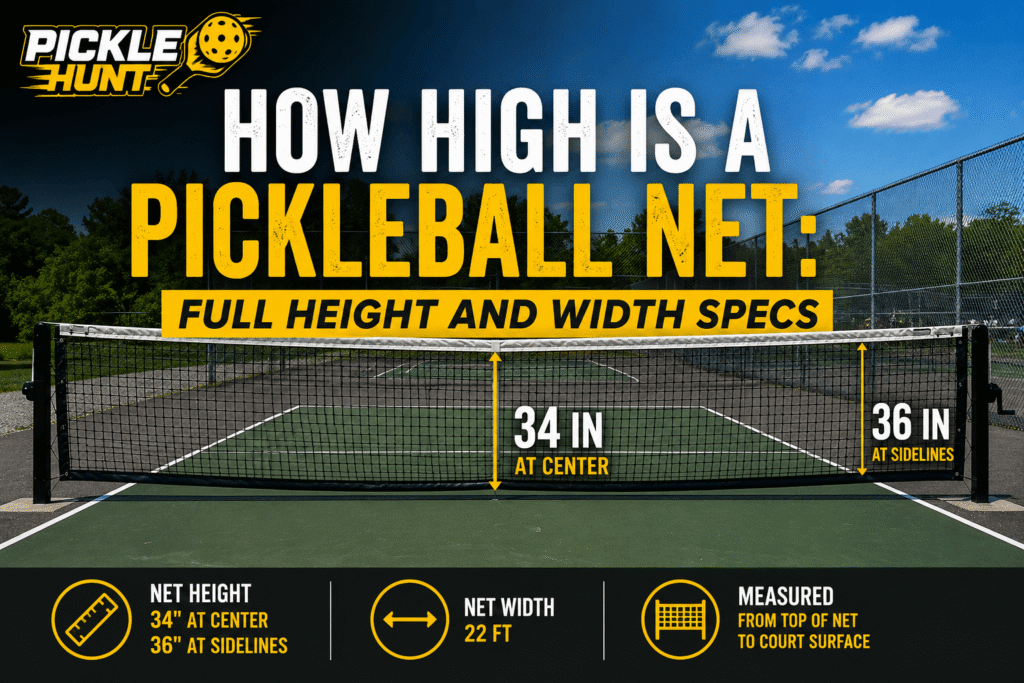
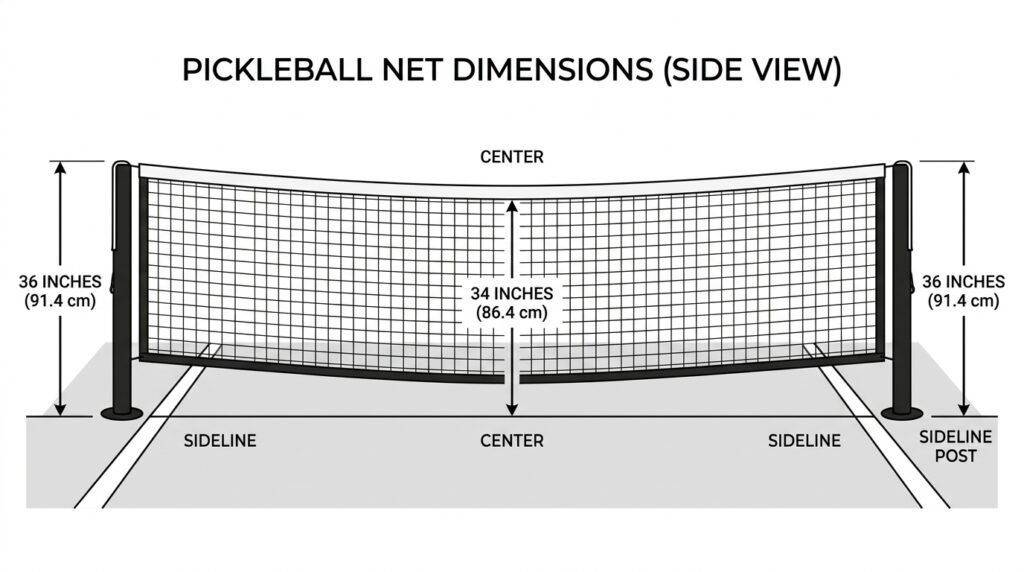
A regulation pickleball net stands 36 inches high at the sidelines and 34 inches at the center. That two inch difference is intentional. The net is supposed to sag toward the middle, not stay perfectly flat like a tennis net does.
If you’re standing next to a net right now trying to figure out if your setup is correct, that’s the number you need. Sideline posts at 36 inches, center at 34. If your net measures the same height all the way across, something’s off, and we’ll get into exactly why that matters and how to fix it.
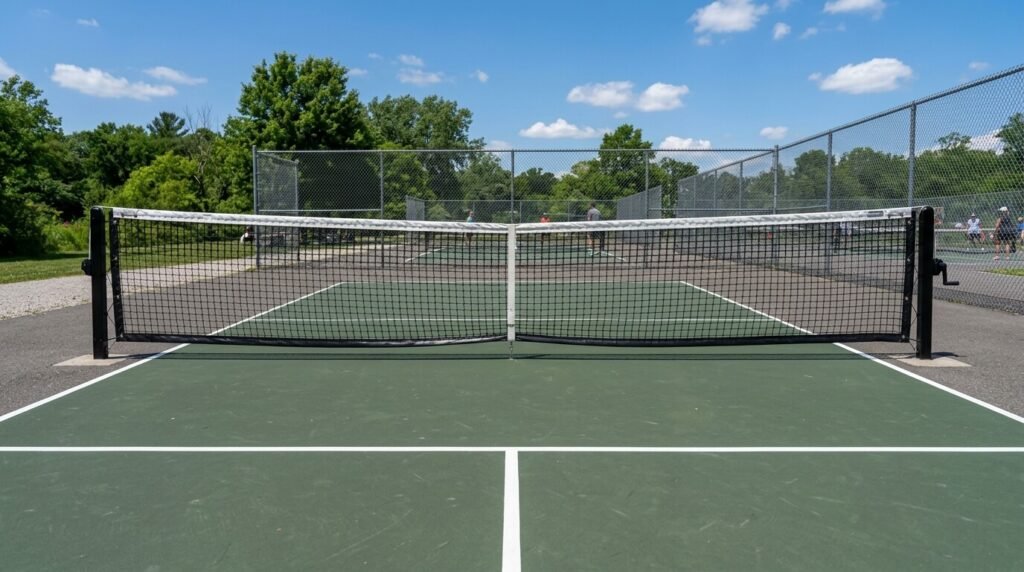
Pickleball Net Specs Table
| Spec | Measurement |
| Height at sidelines | 36 inches |
| Height at center | 34 inches |
| Net length | 21 feet 9 inches (net posts included) |
| Net material | Mesh, openings no larger than 7/8 inch |
| Post placement | 22 inches outside each sideline |
| Court width (net spans full width) | 20 feet |
These numbers come straight from the official USA Pickleball equipment standards, and they’re worth bookmarking if you’re setting up a court or buying gear for the first time.
How Tall Is a Pickleball Net at the Sidelines vs Center
The sideline measurement is the one most people quote when someone asks how tall a pickleball net is, and it makes sense since it’s the higher, more commonly referenced number. But if you only set your net to 36 inches everywhere, you’ve built something that doesn’t match regulation play.
Here’s the thing that trips people up: manufacturers usually give you a strap or center support specifically because getting that 34 inch center height right requires more than just cranking the posts up. The posts control the sideline height. The center strap controls how much sag you’re pulling into the middle. Skip the strap, and your net stays flatter than it should, sitting closer to 36 inches across the board instead of dipping down to 34.
I learned this one the hard way at a portable net I set up for a weekend tournament. Posts looked perfect. Center strap was loose and forgotten in the bag. Every ball that clipped the middle of the net during warm ups sailed through cleaner than it should have, and one of the players who’d been competing for years called it out within five minutes. That center sag isn’t decoration. It changes how the ball interacts with the net on shots that catch the middle.
Why the Center Is Lower on Purpose
This isn’t an accident carried over from tennis or some arbitrary design choice. The lower center height directly affects how shots that travel through the middle of the court behave, particularly on drives and passing shots that split the two players on the other side.
A shot through the middle of the court is already a common tactical choice in pickleball, since it can create confusion between partners about who takes the ball. With a 34 inch center instead of a flat 36 inches, those middle shots have a slightly higher percentage chance of clearing the net compared to a flat net height. It’s a small margin, a couple of inches, but at the pace pickleball is played, small margins show up constantly.
The sag also reflects how the game evolved from a mix of badminton, tennis, and ping pong. None of those sports use a completely flat net line either, and pickleball’s version splits the difference in a way that keeps net play fast without making the middle of the court a wall.
Net Width and Length Explained
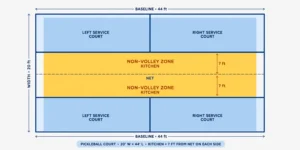
A pickleball court is 20 feet wide, and the net needs to span that entire width plus extend slightly past each sideline where the posts sit. That’s why the official net length comes in at 21 feet 9 inches including the posts, giving you enough net to cover the full court width with the posts anchored just outside the lines.
Post placement matters more than people expect. Each post sits 22 inches outside the sideline, not right on the line itself. If you cram your posts in closer to save space or because your portable net kit came with shorter side straps, you’ll end up with a net that doesn’t fully clear the width of play, and balls can slip past the edges in ways that wouldn’t happen with correct placement.
For anyone setting up on a dual-line court where pickleball and tennis lines overlap, this width difference is one more reason you can’t just borrow the tennis net setup and call it done. More on that below.
Are Pickleball and Tennis Nets the Same Height?
No, and this is one of the more common mix-ups for players coming from tennis or sharing a court that has both sets of lines painted on it. A tennis net sits at 3 feet (36 inches) at the posts and drops to 3 feet even at the center, which is only a slight dip compared to pickleball’s more pronounced 2 inch difference.
The bigger issue isn’t the small height gap, though. It’s that tennis nets are strung for a court that’s 78 feet long and 27 to 36 feet wide depending on singles or doubles, spanning a completely different width than a pickleball court. If you’re playing on a shared or converted court, you generally need a separate, properly sized pickleball net rather than trying to adjust a tennis net down to size. Portable pickleball nets exist specifically to solve this, letting you set up regulation height and width on any flat surface without touching the permanent tennis net.
Trying to lower a tennis net and call it pickleball ready usually gets you a net that’s too wide for the court, strung at the wrong tension, and missing that intentional center sag altogether.
How to Set Up a Pickleball Net Correctly
Getting a portable net to actual regulation height takes more than eyeballing it, and most of the mistakes people make happen because they check height at the wrong spot or skip a step entirely.
Start with the posts. Extend both posts to 36 inches, measuring from the ground straight up to the top of the net binding, not the top of the pole itself. Most portable nets have a locking mechanism or telescoping pole marked with height notches, but don’t trust the notch blindly if the net has been used for a season or two. Plastic locks wear down and posts can settle lower than the marked line.
Tension the net across. Pull the net taut between the posts using the built in ratchet or strap system most portable nets come with. Too loose and you’ll get sag everywhere, not just at the center. Too tight and you’ll fight the center strap in the next step.
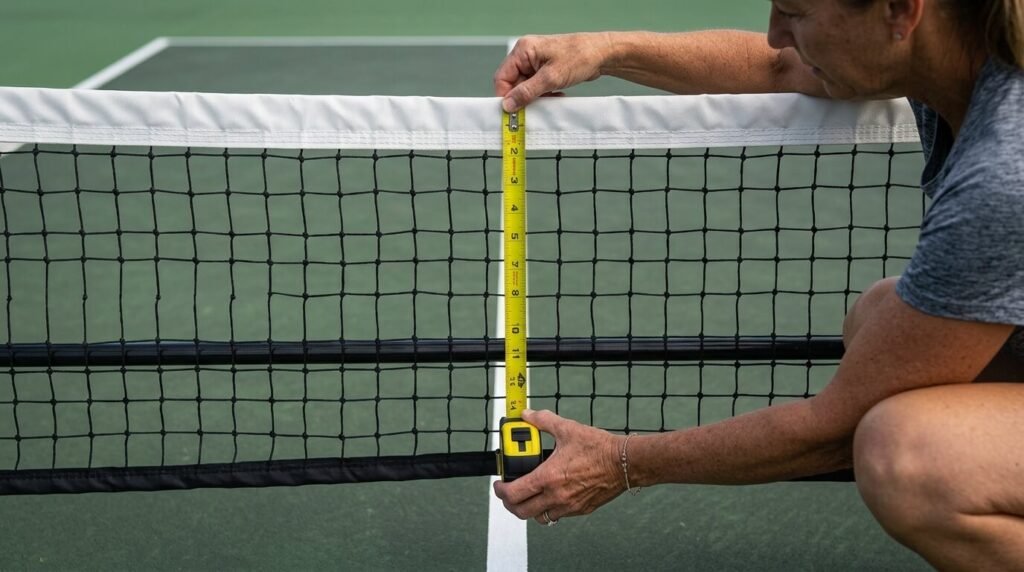
Set the center height using the strap or clip. This is the step people skip. Nearly every regulation compliant portable net includes a center strap that clips onto the net and pulls it down to 34 inches. Attach it, then physically measure at the center of the net, not near a post, to confirm you’ve hit 34 inches.
Measure twice, at both spots. Use an actual tape measure at the sideline post and again at the dead center of the net. Don’t rely on how it looks. A net that looks about right from a few feet away is very often off by an inch or more once you actually measure it.
Common Net Setup Mistakes
The most frequent mistake is checking height only at the posts and assuming the center falls into place on its own. It doesn’t. Without the center strap actively pulling the net down, most nets sag less than 34 inches worth in the middle, or in cheaper models, barely sag at all.
Sagging too far the other direction is just as common with budget nets, especially after repeated use. The mesh stretches, the tension system loosens, and after a season of matches a net that started at correct height can droop to 30 or 31 inches at the center without anyone noticing until a shot that should’ve been out clips the tape and drops in. If you own a portable net and haven’t measured it in a while, it’s worth checking. A lot of cheaper nets simply won’t hold regulation height past a few dozen uses, and no amount of tension adjustment fully fixes worn out mesh.
Uneven post tension is another one. If one side of the net is pulled tighter than the other, you get an asymmetrical sag that throws off height on one half of the court while looking fine on the other. Walk the full width and check both halves separately, not just one measurement and call it done.

What to Look for in a Portable Net
If you’re shopping for a net rather than fixing one you already own, regulation compliance should be the first filter, not the last. Look for listings that specifically state USA Pickleball approved dimensions, including the center strap or clip system, since that’s the piece that gets left out of the cheapest models entirely.
Steel or aluminum poles tend to hold height better over time than the all plastic versions, and a wheeled carrying case matters more than it sounds like it would if you’re hauling the net to different courts regularly.
Frequently Asked Questions
How tall is a pickleball net?
A pickleball net is 36 inches tall at the sideline posts and drops to 34 inches at the center, where it’s meant to sag slightly by design.
How wide is a pickleball net?
A regulation net spans 21 feet 9 inches including the posts, covering the full 20 foot width of the court with the posts placed 22 inches outside each sideline.
Are pickleball and tennis nets the same height?
No. Tennis nets sit at 36 inches at the posts and 36 inches at the center, while pickleball nets drop to 34 inches in the middle, a more noticeable sag built into the rules on purpose.
How do I set up a pickleball net correctly?
Extend the posts to 36 inches, tension the net across, then use the center strap to pull the middle down to 34 inches and confirm with an actual tape measure rather than guessing by eye.
Can I play pickleball on a converted tennis court?
You can, and it’s common, but you’ll need a separate pickleball sized net rather than adjusting the tennis net. Check out our Can You Play Pickleball on a Tennis Court article for the full breakdown, and browse the Court Directory page to find courts already set up correctly near you.