 How To
What’s the Difference Between Pickleball and Tennis?
Pickleball and tennis look related from a distance. Up close, they’re different sports. The pickleball court is roughly a third the size of a tennis court. Pickleball uses a solid paddle and a perforated plastic ball instead of a strung racket and a felt ball. Scoring works differently too: pickleball uses rally or side-out scoring to 11, while tennis runs on games, sets, and the deuce system. Those four differences (court, equipment, scoring, and the physical demand that follows from them) are what actually separate the two games.
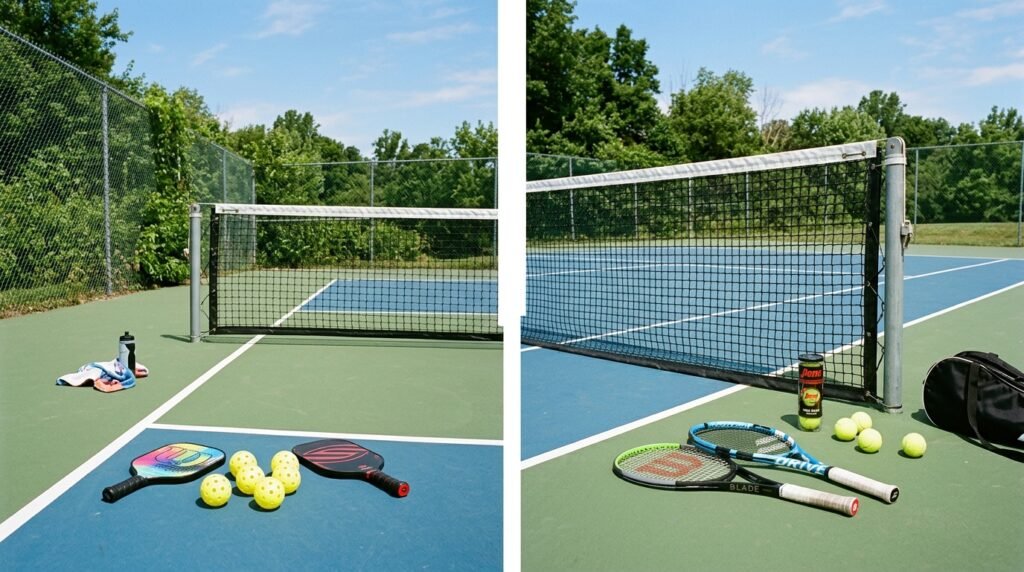
If you’re deciding which sport fits you better, or you’re a tennis player wondering how hard the switch will be, here’s the full breakdown.
Court Size: Pickleball Is About a Third the Size
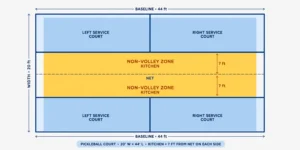
A regulation pickleball court is 20 feet by 44 feet, same dimensions as a doubles badminton court. A tennis court is 78 feet by 27 feet for singles, 78 feet by 36 feet for doubles. Lay them side by side and the pickleball court fits inside the tennis court with room to spare.
That size gap changes how each game gets built. Because pickleball courts are smaller, four of them can fit inside the space of a single tennis court. That’s part of why so many tennis courts are getting lined or converted for pickleball. If you’re curious whether your local tennis court can double as a pickleball court, we cover that in detail in Can You Play Pickleball on a Tennis Court?.
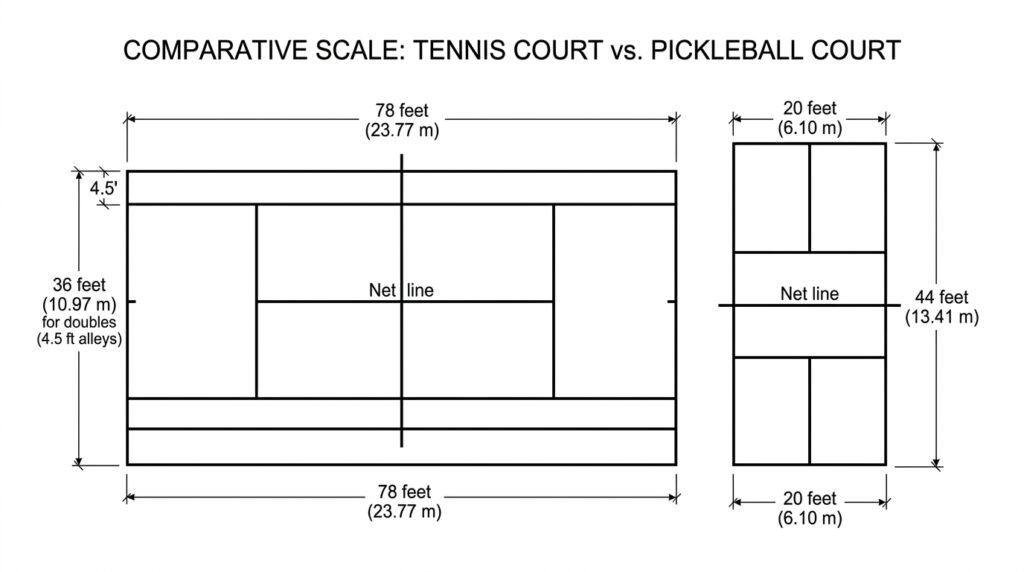
The smaller court also means less ground to cover per point. In tennis, a wide serve can pull you feet off the baseline. In pickleball, most of the action happens in a tighter band near the net, which changes the physical demands entirely (more on that below).
Equipment: Paddle and Plastic Ball vs Racket and Felt Ball
This is the difference between pickleball and tennis that people notice first.
Pickleball paddle: A solid piece of composite, graphite, or wood, usually 15.5 to 17 inches long, no strings. No tension to manage, no restringing.
Tennis racket: A strung frame, usually 27 inches long, with a hitting surface that depends on string tension and pattern. Restringing and grip maintenance are part of owning one.
Pickleball ball: A hollow, perforated plastic ball, similar to a wiffle ball but harder. Indoor and outdoor versions have different hole patterns for different flight characteristics.
Tennis ball: A pressurized rubber core covered in felt. It compresses on contact and requires more racket-head speed to generate pace.
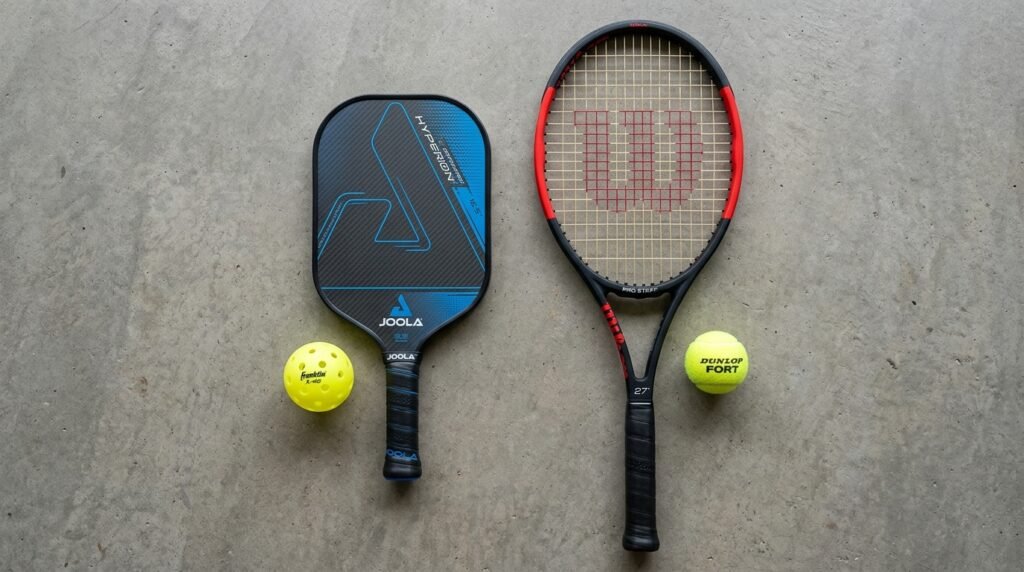
The paddle and ball combination is why pickleball rallies sound and feel different. Less string bed means less natural power, so points tend to be built on placement and patience rather than raw pace, at least until you get into the upper skill levels.
Scoring: Rally Points vs Games and Sets
Tennis scoring runs on games (love, 15, 30, 40, game) grouped into sets, with a deuce and ad-point system when a game reaches 40-40. Matches are usually best of three sets, best of five at the pro level.
Pickleball scoring is simpler on paper. Games are typically played to 11, win by 2. Traditional pickleball uses side-out scoring, meaning only the serving side can score a point, and the serve rotates through both players on a team before switching to the opponents. Newer formats have introduced rally scoring, where every rally scores a point regardless of who served, which speeds up match length.
You also only serve from one side in pickleball, and there’s a two-bounce rule requiring the ball to bounce once on each side before volleys are allowed. That rule, along with the no-volley zone (the “kitchen”), shapes almost every strategic decision in the game. We go deep on that in our Rules and Kitchen guide.
Physical Intensity and Learning Curve
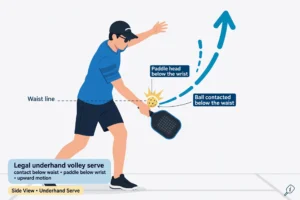
Is pickleball easier than tennis to learn? For most beginners, yes. The smaller court means less running, the underhand serve is easier to execute consistently than an overhand tennis serve, and the learning curve to hit a functional shot is shorter. Most new players can sustain a rally within their first session.
Tennis has a steeper technical entry point. Serving overhand with consistent placement, generating topspin, and covering a full singles court all take real time to develop. That doesn’t make tennis harder to enjoy, it just means the gap between a first-timer and a competent player is wider.
That said, “easier to start” doesn’t mean “easy to master.” Competitive pickleball at 4.5+ DUPR levels demands sharp reflexes, precise dinking, and fast hands at the net, especially in doubles. The ceiling is high even if the floor is low.
Physically, tennis tends to demand more sustained cardio and full-court coverage, especially in singles. Pickleball is lower impact and easier on the joints, which is a big reason it’s popular with older players and people recovering from injury, but doubles pickleball at speed still gets your heart rate up fast, particularly during net exchanges.
Who Each Sport Tends to Suit Better
Neither sport is objectively better. They tend to suit different players and situations.
Pickleball tends to fit well if you:
- Want a shorter learning curve and faster access to real rallies
- Prefer a lower-impact game that’s easier on knees and shoulders
- Have limited court access, since pickleball courts are more common and often free at local parks
- Like a social, doubles-heavy format
Tennis tends to fit well if you:
- Want a higher ceiling for singles competition and full-court athleticism
- Already have a racket sports background and want more power and spin variety
- Have consistent access to tennis courts or a club
- Enjoy longer, more physically demanding matches
A lot of players end up doing both. The skills cross over more than people expect, and comparing them side by side is a good way to figure out where to spend your court time. Speaking of court time, you can find courts for either sport near you on our Court Directory.
Comparison Table: Pickleball vs Tennis
| Category | Pickleball | Tennis |
|---|---|---|
| Court size | 20 ft x 44 ft (about 1/3 the size of a tennis court) | 78 ft x 27 ft singles, 78 ft x 36 ft doubles |
| Equipment | Solid paddle, no strings | Strung racket |
| Ball | Perforated plastic ball | Pressurized felt-covered ball |
| Scoring | Games to 11, side-out or rally scoring | Games, sets, deuce/ad scoring |
| Rules highlight | Two-bounce rule, no-volley zone (kitchen) | No kitchen rule, full-court volleys allowed |
| Physical intensity | Lower impact, shorter bursts, especially in doubles | Higher cardio demand, more full-court running |
| Learning curve | Shorter for beginners | Steeper, especially serve and topspin |
FAQ
What is the difference between pickleball and tennis?
The main differences are court size, equipment, and scoring. Pickleball is played on a smaller court with a solid paddle and plastic ball, using games to 11. Tennis uses a larger court, a strung racket, a felt ball, and games/sets scoring.
Is pickleball easier than tennis?
For most beginners, yes. The smaller court, simpler serve, and lighter paddle make it faster to learn the basics. Mastering it at a competitive level still takes real skill and practice.
How is pickleball different than tennis?
Beyond court and equipment, pickleball has unique rules like the two-bounce rule and the no-volley zone near the net, neither of which exist in tennis. These rules push pickleball strategy toward placement and net play rather than power.
Can a beginner switch from tennis to pickleball easily?
Yes. Tennis players usually adapt quickly because hand-eye coordination and court awareness carry over. The main adjustments are getting used to a shorter paddle, a lighter ball, and the no-volley zone.
Ready to stop losing points you shouldn’t? Grab The Ultimate Pickleball Playbook and start playing like it. Get it here – $27